Spiritual Revolutionary | Krishnamurti by Henri Methorst
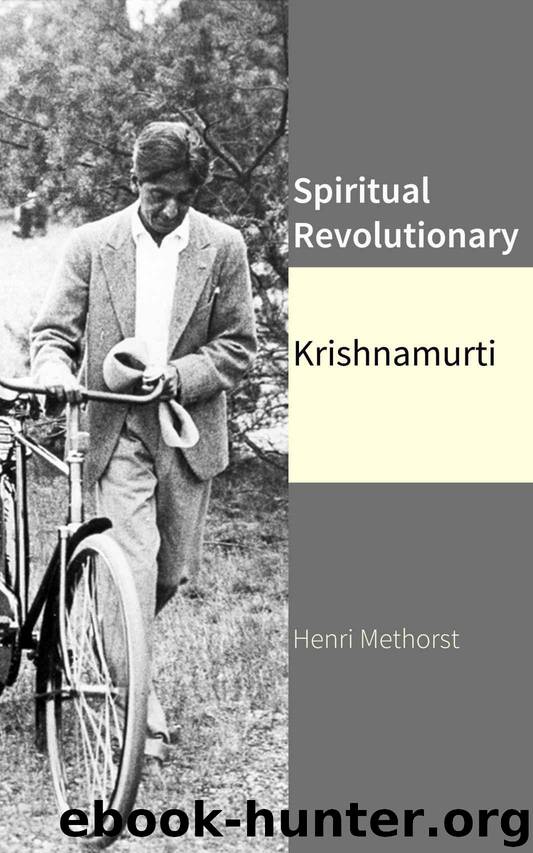
Author:Henri Methorst
Language: eng
Format: mobi, epub
Publisher: Karina Library Press
Published: 2017-03-29T04:00:00+00:00
Rajagopal’s aggression had evolved subconsciously over the course of many years. I view this outcome as the tragedy of a highly gifted but difficult and authoritarian personality, who had expected greater acclaim for Krishnamurti and thus for himself as the great teacher’s assistant. Possibly Krishnamurti was more of a spiritually revolutionary figure than he could accept or even understand.
13 TALKS AND INTERVIEWS: THE PRIVATE/PUBLIC PARADOX
I have always been skeptical as to the value of private problem-solving interviews with a man like Krishnamurti because his mentality and approach to problems was so fundamentally different to everyone else’s. He realized that personal problems result from personal idiosyncrasies, from personal beliefs, from grief and misunderstanding, from education, habits, fears and remembered experiences. Seen in this light, no other person can solve the problems of another.
Naturally, if we know there is someone superbly wise at hand, who by their understanding and love has somehow transcended these problems, we hope they will be able to set us free or at least show us the way to freedom—but what happens in discussion with Krishnamurti is that we discover there is no ready-made solution to our problems—the paradox being that the problem appears concrete and real but is in fact a creation of our mind. The wise man is somehow on another level of consciousness, whereas the questioner is tied to the past and nothing seems to bridge the gap between the two.
I would even suggest this is the reason why the majority of members of religious, esoteric or spiritual movements will find Krishnamurti’s approach unpractical and inefficient, not to say puzzling and disappointing. For unlike traditional spiritual leaders, he offers no discipline or meditation to dispel suffering and fear, no training in “higher consciousness and love,” and no surrendering to Christ or Buddha. The fact is that Krishnamurti knew full well what makes the individual suffer and why he seeks the superficial way out. Krishnamurti was an excellent psychologist who had both lived in and been educated in the East and the West, and he knew that if the answer to a problem was only to be found in the intense awareness of it, that was precisely what the person with the problem was trying to avoid.
The situation, as far as I can judge, was somehow different when attending one of Krishnamurti’s public talks or dialogues. As a matter of principle, Krishnamurti did not offer the solution to a neurotic problem or even to fear in general; that is something for the psychologist or psychiatrist. He knew that these problems are solved, not because another person, even a saint, offers us a solution, but because we suddenly see the problem in a totally different light. It is my personal experience of listening to Krishnamurti in different periods of my life, that—even with 2,000 people seated in one hall or tent—these public talks were far more efficient, more revealing and productive than a personal conversation. During a talk, or when reading one of his books, there is no pressing demand for a solution to a personal problem.
Download
Spiritual Revolutionary | Krishnamurti by Henri Methorst.epub
This site does not store any files on its server. We only index and link to content provided by other sites. Please contact the content providers to delete copyright contents if any and email us, we'll remove relevant links or contents immediately.
Endurance: Shackleton's Incredible Voyage by Alfred Lansing(4788)
The Motorcycle Diaries by Ernesto Che Guevara(4106)
Alive: The Story of the Andes Survivors by Piers Paul Read(4037)
Tokyo Vice: An American Reporter on the Police Beat in Japan by Jake Adelstein(3998)
Exit West by Mohsin Hamid(3830)
Apollo 8 by Jeffrey Kluger(3716)
Aleister Crowley: The Biography by Tobias Churton(3646)
Annapurna by Maurice Herzog(3477)
Full Circle by Michael Palin(3455)
Into Thin Air by Jon Krakauer(3403)
Kitchen confidential by Anthony Bourdain(3099)
In Patagonia by Bruce Chatwin(2936)
A Wilder Time by William E. Glassley(2865)
Finding Gobi by Dion Leonard(2847)
The Ogre by Doug Scott(2688)
Into the Wild by Jon Krakauer(2637)
The Stranger in the Woods by Michael Finkel(2544)
L'Appart by David Lebovitz(2522)
An Odyssey by Daniel Mendelsohn(2310)
